Psalm 126
On taking up his post at Gonville and Caius College in 1960, Peter Tranchell inherited a Choir of 12 male voices, made up of tenors, baritones and basses. He quickly realised that singing the psalms to traditional Anglican chant was not satisfactory with a male-voice choir. In The Caian of 1971 he wrote: “Bishop Hugh Montefiore, when Dean of the College, was responsible for the introduction of special musical settings of the psalms, with illuminating refrains. After ten years, the tradition has crystallised into the singing of these settings as a regular item at evensongs on Thursdays.” Although not an admirer of Gelineau’s settings, Tranchell wanted to emulate the responsorial structure with the congregation singing a repeating antiphon between the verses which are sung by the choir. Occasionally, the melody of the psalm or the antiphon is developed from an appropriate plainsong melody, as in Psalm 150. Above all, though, he wanted the music to be attractive and memorable.
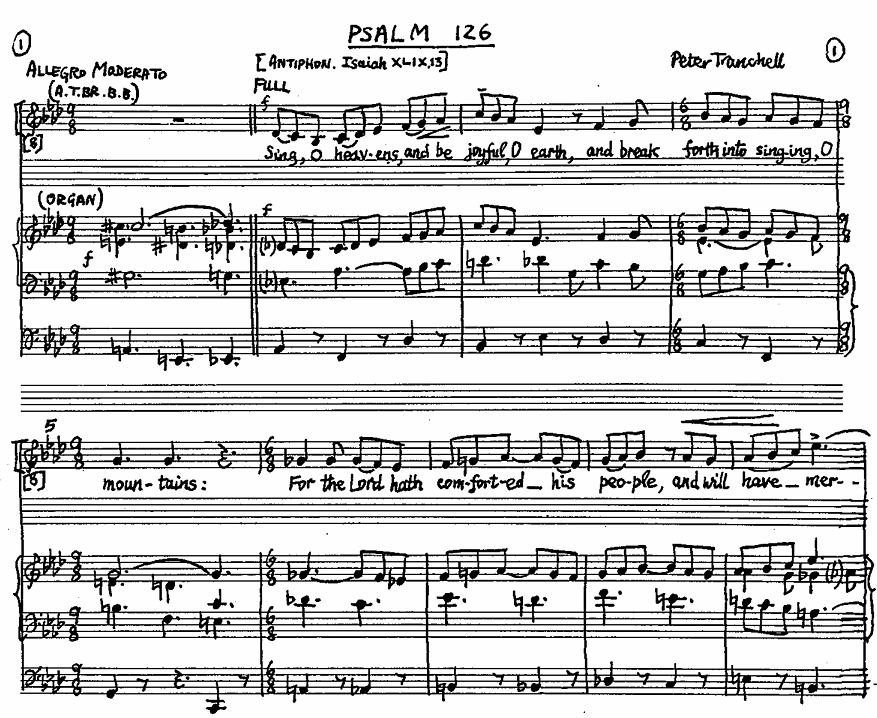
Peter Tranchell wrote this setting of Psalm 126 in 1962 for unison voices and organ. The antiphon is Isaiah XLIX, 13: "Sing, O heavens, and be joyful, O earth, and break forth into singing, O mountains: for the Lord hath comforted his people, and will have mercy upon his afflicted".
In 1968 Tranchell simplified/arranged the 1962 versions of Psalms 15 and 126 for publication in New Songs for the Church: Book 1 produced in 1969 by Galliard Ltd for the Scottish Churches’ Council, which hoped that the use of the book might ‘inject into public worship a new kind of sincerity and gaiety’.
In 1980 he arranged the setting again, for Tenor solo, ATBrBB and organ, with a slightly altered organ part.
In 2018 the Galliard setting* was republished along with Psalms 15 and 133 by CMS, as Peter Tranchell, Three Responsorial Psalms (CMS 046), and copies may be purchased via RCMS here.
* The CMS edition is identical to the Galliard 1969 edition, apart from some minor typos/omissions in the CMS edition, as follows:
- Bar 20 (&41) beat 1: organ pedal D flat should be D natural.
- Bar 56 (verse 5) voice: missing mp dynamic for "Turn our captivity...".
- Bar 60 voice: missing mf dynamic for "They that sow...".
- Bar 60 beat 3 voice and organ: missing crescendo hairpin.
- Bar 62 voice and organ: missing crescendo hairpin, leading to f.
- Bar 63 voice: missing accent on "joy".
- Bar 76 voice: missing mf dynamic for "He that now goeth...".
- Bar 79 voice: missing crescendo hairpin on "beareth forth".
- Bar 80 voice: missing decrescendo hairpin on "seed".
- Bar 81 voice and organ: missing crescendo hairpin on "doubtless come" and f dynamic for "joy".
- Bar 84 organ: the Galliard edition does not have a crescendo in the organ part.
- Bar 92 organ beat 1: missing crescendo hairpin.
- Bar 95: missing rit.
The CMS edition has corrected a typo in the Galliard edition, which had bar 5 beat 3 organ LH as an E flat.