1974 LP of a Recital in Gloucester Cathedral
1974 LP of a recital in Gloucester Cathedral by the Boys' Choir of The Blue Coat School Birmingham with The Men's Choir of Gonville & Caius College, Cambridge.
We've been sent this photo of the reverse of an LP sleeve from 1974. We're trying to get hold of the recording itself, and have some promising leads.
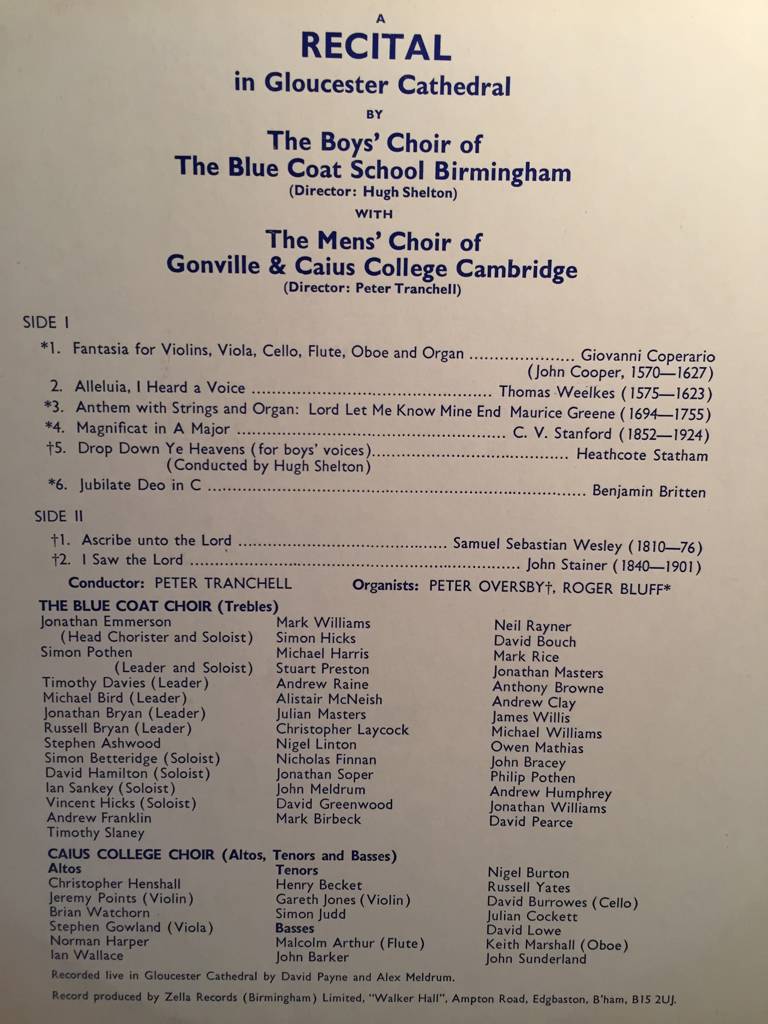
The album notes
These notes were included with the album, as shown in the extract image below, written by "A.E.H & H.N.A.S" (believed to be Hugh Shelton and Anthony Harvey, a colleague of Hugh at Birmingham Bluecoat School and a key figure for many years in the Friends of Cathedral Music in Birmingham (Nigel Day, pers. comm.)).
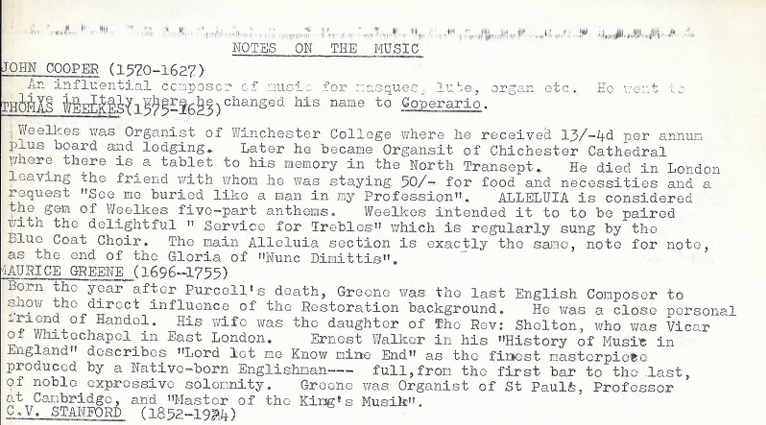
NOTES ON THE MUSIC
JOHN COOPER (1570-1627)
An influential composer of music for masques, lute, organ etc. He went to live in Italy where he changed his name to Coperario.
THOMAS WEELKES (1575-1623)
Weelkes was Organist of Winchester College where he received 13/-4d per annum plus board and lodging. Later he became Organist of Chichester Cathedral where there is a tablet to his memory in the North Transept. He died in London leaving the friend with whom he was staying 50/- for food and necessities and a request "See me buried like a man in my Profession". ALLELUIA is considered the gem of Weelkes five-part anthems. Weelkes intended it to be paired with the delightful "Service for Trebles" which is regularly sung by the Blue Coat Choir. The main Alleluia section is exactly the same, note for note, as the end of the Gloria of the "Nunc Dimittis".
MAURICE GREENE (1696-1755)
Born the year after Purcell's death, Greene was the last English composer to show the direct influence of the Restoration background. He was a close personal friend of Handel. His wife was the daughter of The Rev: Shelton, who was Vicar of Whitechapel in East London. Ernest Walker in his "History of Music in England" describes "Lord let me Know mine End" as the finest masterpiece produced by a Native-born Englishman--- full, from the first bar to the last, of noble expressive solemnity. Greene was organist of St Paul's, Professor at Cambridge, and "Master of the King's Musik".
C.V. STANFORD (1852-1924)
An Irish Protestant born in Dublin, he won an Organ Scholarship to Cambridge. He was appointed Organist of Trinity College in 1873 and Professor in 1887. Although Stanford wrote some 200 works, it is his Church Compositions that have stood the test of time. The well-known and ever popular B flat Service was published in 1879. The Setting in A followed a year later. The was a larger work intended for orchestral accompaniment and composed for a festival of the "Sons of Clergy", held in St Paul's Cathedral. Especially noteworthy is the powerful Gloria which Stanford scored for double-choir.
HEATHCOTE STATHAM (1889-1973)
Dr Statham composed this delightful two-part anthem for treble voices shortly after the war. He became Organist of Norwich Cathedral in 1928 and for forty years was most active in the musical life of East Anglia.
BENJAMIN BRITTEN JUBILATE IN C
Written at the request of H.R.H. The Duke of Edinburgh, it was performed in St George's Chapel Windsor under the direction of Sir William Harris.
ASCRIBE UNTO THE LORD - S.S. WESLEY (1810-76)
Samuel Sebastian Wesley was the illegitimate Son of the Composer Samuel Wesley, the Grandson of Charles Wesley the hymn writer, and the great Nephew of John Wesley, the founder of "Methodism". S.S. Wesley was a Chorister at the Chapel Royal. At the early age of 22, he became Organist of Hereford Cathedral. This was followed in succession by appointments at Exeter Cathedral, Leeds Parish Church, Winchester and Gloucester Cathedrals. He held the highest ideals for music in Cathedrals at a time when traditions and standards had reached their lowest ebb. He was therefore in constant conflict with officialdom and vested interests. His compositions were intended to replace much of the very inferior music which had gradually infiltrated the leading churches of the country. "Ascribe unto the Lord" is on a grand scale, so much so that it receives few performances today. It must be remembered that in days gone by people were prepared and willing to spend much of Sunday in Church!
I SAW THE LORD - JOHN STAINER (1840-1901)
Stainer became a Chorister at St Paul's Cathedral at the early age of seven. At 16 he became Organist at St Michael's College Tenbury Wells and later he succeeded Sir John Goss as Organist of St Paul's Cathedral. He was an accomplished musician, first-rate administrator, scholar and musicologist of no mean repute. Many of his compositions are now best forgotten. "Crucifixion" seems to have had a revival in recent years. "I Saw the Lord" is an inspired piece of eight-part writing and worthy of inclusion in any Cathedral music list today. It was obviously planned with the spaciousness and acoustics of St Paul's Cathedral in mind. The anthem contains three sections, therefore symbolizing the Trinity. Its recent revival has been due to the efforts of George Guest, Organist of St John's College Cambridge in including the anthem on one of the Choir's earliest LP records.
Notes by A.E.H. & H.N.A.S.
ADVICE ON REPRODUCTION OF RECORD
For best results on average sets the treble tone should be turned up to maximum; Otherwise the boys tone will not sound through and words will not be clear. The General volume control should also be kept on the high side.