Maurice Holt's memories of Peter Tranchell in the early 1950s
- Posted in:
- about PAT
PETER TRANCHELL
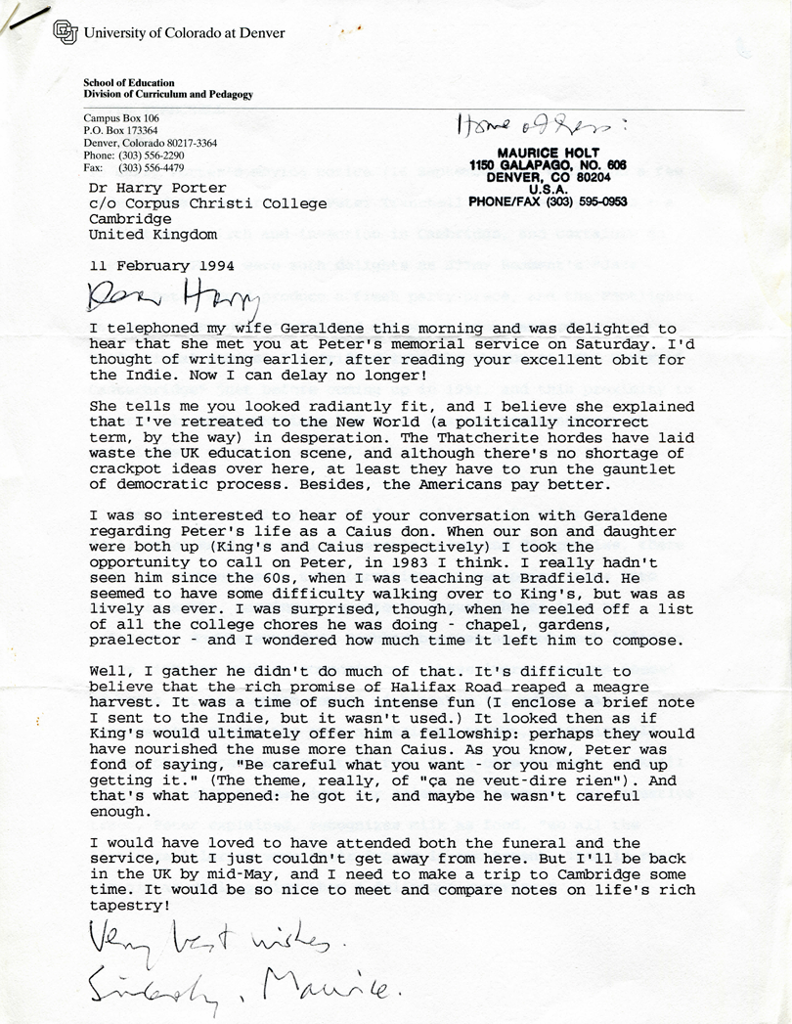
To Harry Porter's moving notice (16 September [1992, The Independent]), I would add a few undergraduate memories of Peter Tranchell in the early 1950s - a time of much mirth and invention in Cambridge, and certainly so for Peter. There were such delights as Jimmy Beament's "Jazz Mass" [sic - was this a PAT take on Geoffrey Beaumont's Folk Mass, published 1956?], Peter would produce a fresh party piece, and the Footlights was still a students' club and not yet a boot camp for professional comics. I'd drifted into the chorus of "The Mayor of Casterbridge" just before coming up in 1951, and this proximity to Peter's wit and enthusiasm led to an instant rearrangement of priorities.
Amusement was always on hand at Halifax (affectionately, Scallywags) Road. As well as Peter's tales and discoveries, there were his instantaneous transformations of newspaper items into operatic arias, turning a reporter's casual phrase into an unforeseen double entendre. Perhaps because he took such infinite pains with his written compositions, these improvisations seemed to bring out his impish genius with particular eclat. His conversation showed the same quicksilver talent, quarrying all manner of sources in pursuit of fun. I was once served a cocktail of gin and milk at tea-time, for scientific reasons: the digestive tract, Peter explained, recognizes milk as food, "so all the little capillaries wave their fronds in excitement. Then in rushes the gin as well, giving them a delicious surprise."
But a more lasting pleasure came from the serious business of collaborating with Peter on music and lyrics. Whether writing in salon style to one's libretto for a college May Week production, or in revue style for a Footlights number, every nuance had to "work", and he was immensely fertile at suggesting the tiny changes that transform an effect or enhance a punch line. Brought in at short notice to write some lyrics for "Zuleika", I was soon treated to a crash course in great theatre moments, from Lehar to Puccini, for Peter's memory and keyboard fluency were prodigious. And behind his mock-sinister black suits and unnerving peals of laughter at the follies of humanity, Peter Tranchell was infinitely kind, and wonderfully relentless in identifying philistinism in all its forms. He was a remarkable performer and composer, but an educator too.
MAURICE HOLT
And the cover letter to Harry Porter, to which this was attached: